A reliable ghost mannequin service provider enables fashion brands to present apparel with consistency, precision, and a professional finish. Garments are photographed on a mannequin, which is then removed during post-production. Interior areas such as the collar, sleeves, and hem are carefully composited to create a realistic, three-dimensional appearance.
For US eCommerce businesses, image quality directly influences buyer confidence. Customers cannot examine fabric or test fit in person, so product photography must communicate shape, texture, and detail clearly.
As catalogs expand, maintaining uniform quality across hundreds of images becomes demanding, and many retailers outsource to specialists. This guide explains how to evaluate providers, compare pricing, test sample images, and select a partner that meets your standards, timelines, and budget.
What Are Ghost Mannequin Editing Services?
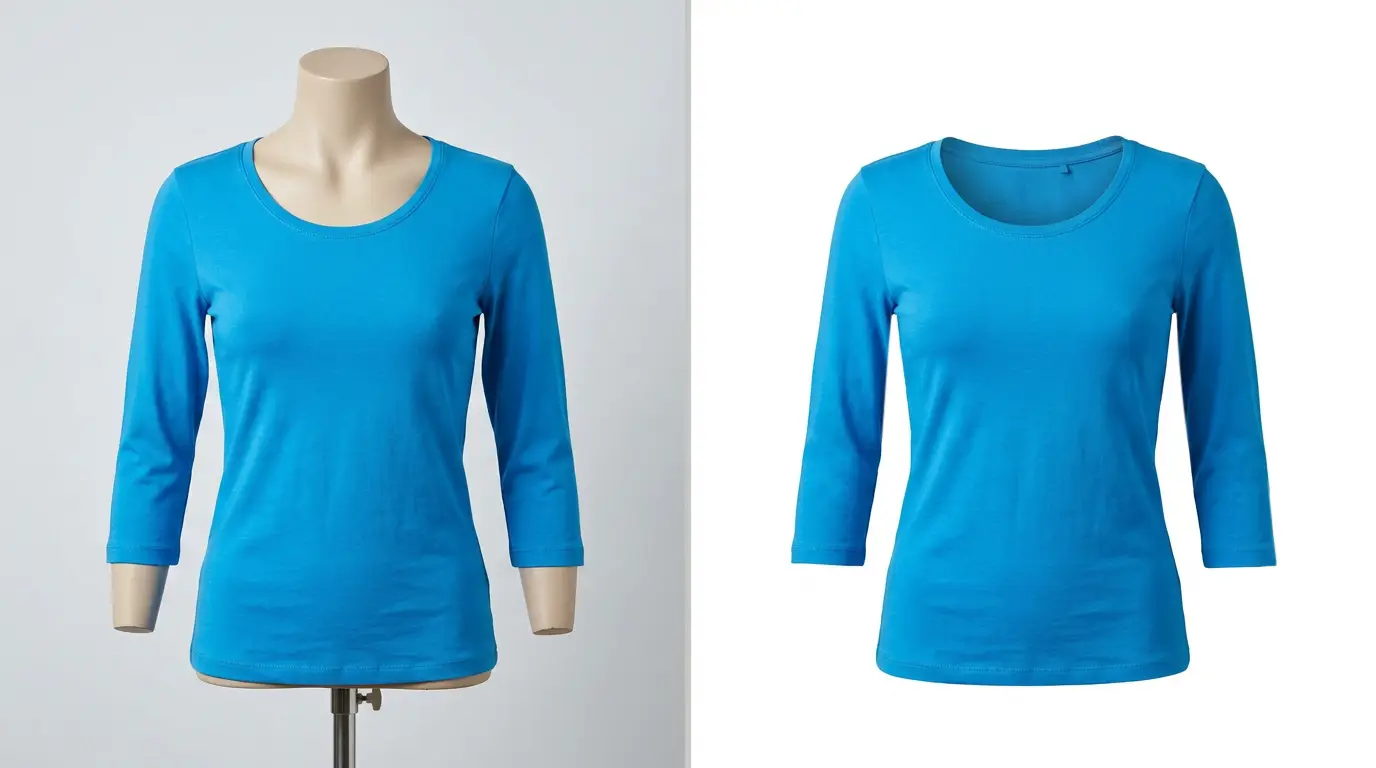
Ghost mannequin editing services take raw photos of clothing on a mannequin and turn them into clean, hollow-form product images. The mannequin disappears, the garment keeps its shape, and the background is usually cleaned up to pure white or another consistent color. If you have heard the terms invisible mannequin, hollow man or 3D ghost effect, they all point to the same finished look.
The service is popular because it sits in a useful middle ground. It looks far more polished than a garment dumped on a table, and it costs much less than hiring models, booking a studio and shooting every item on a person.
How Ghost Mannequin Photo Editing Works
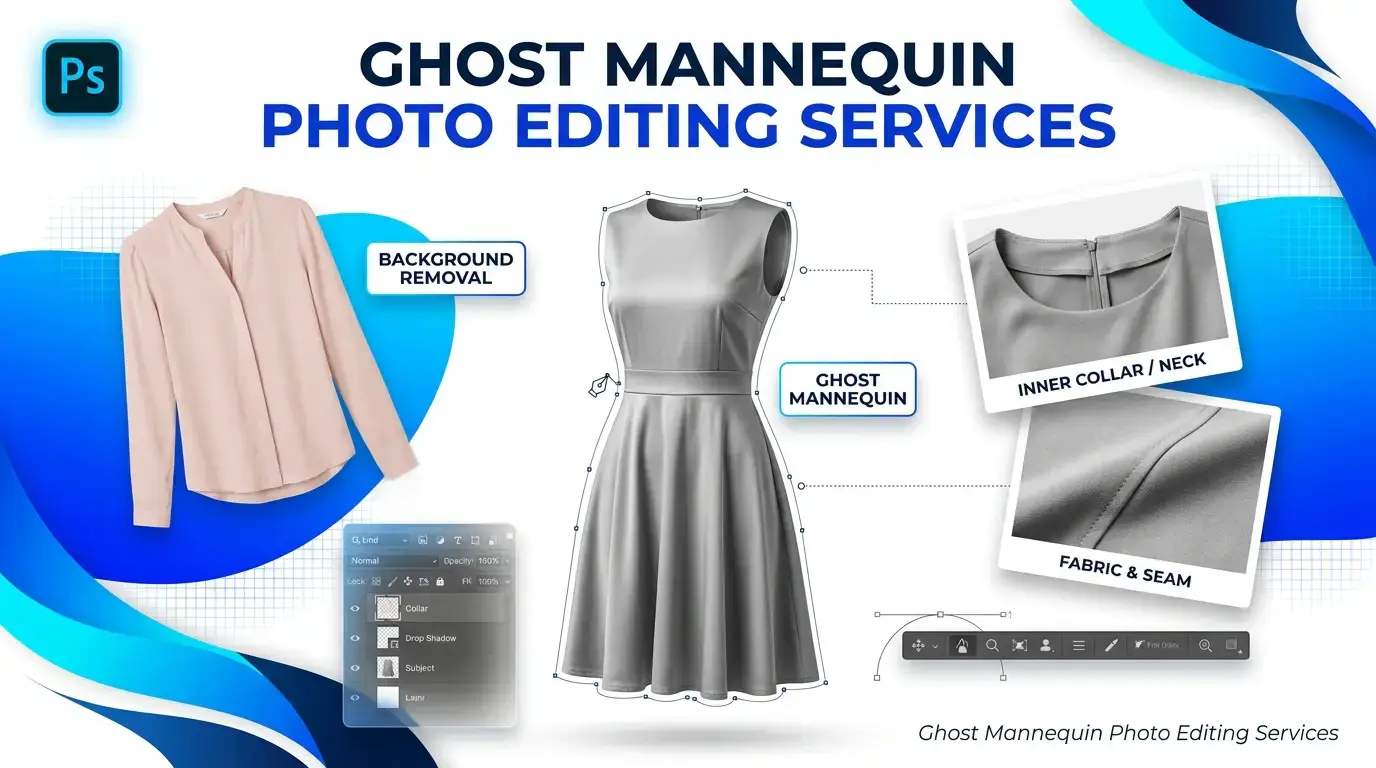
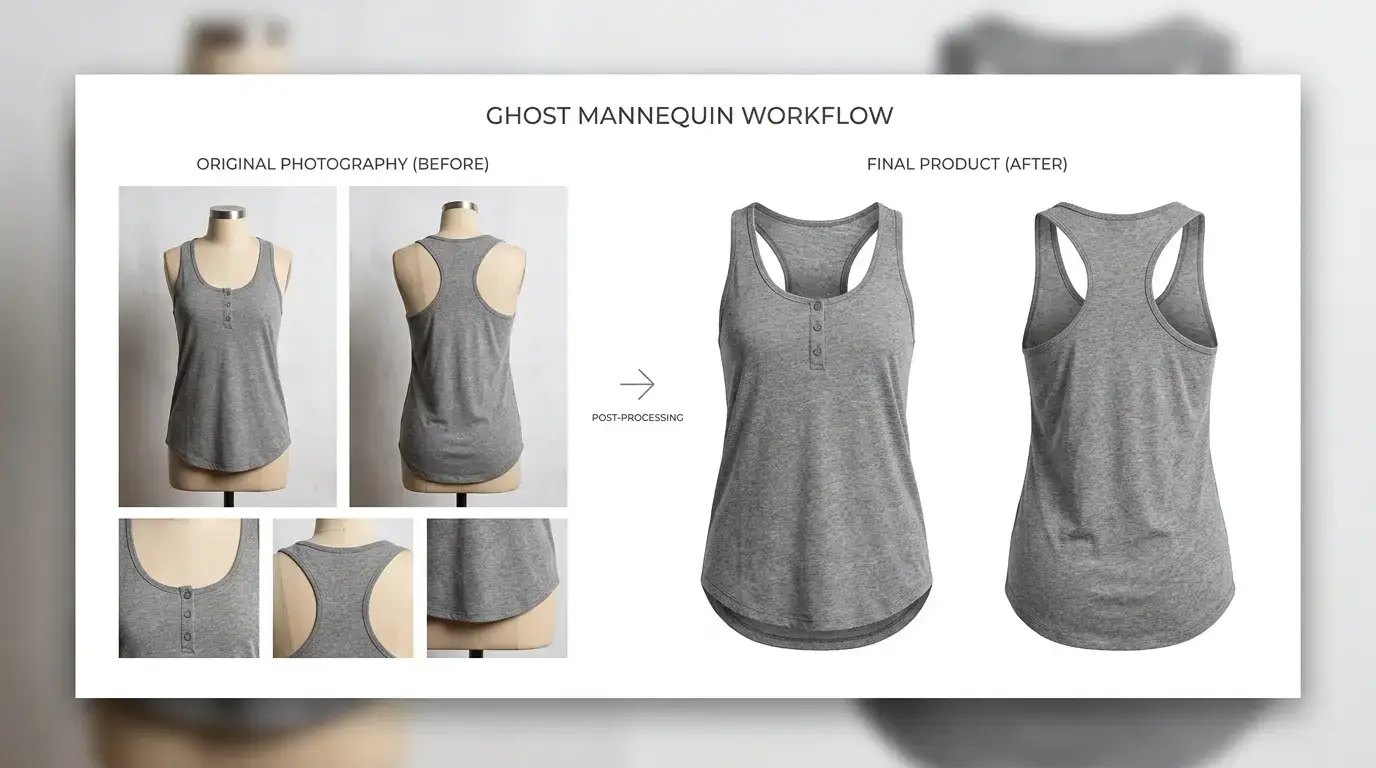
The process begins at the shoot. The photographer dresses the mannequin, styles the garment so it hangs well, and takes the main shot. For many garments, a second photo is taken with the clothing flipped or with the mannequin parts removed, so the back of the neckline and the inside label can be captured.
In editing, the retoucher cuts the garment away from the mannequin and the background. Then the clever part happens. The interior shot is blended into the main image to fill the hollow where the neck, sleeve openings or waistband would be. Wrinkles are smoothed without flattening the fabric texture, symmetry is corrected, and a soft shadow is added so the garment does not look like it is floating in a void.
The quality gap between average and excellent shows up in the details. Rushed work leaves a visible seam at the collar, uneven sleeves, or a shape that looks vacuum-sealed. Careful work looks like the clothing was simply photographed on someone who stepped out of the frame.
Benefits of Ghost Mannequin Photography for Clothing Brands
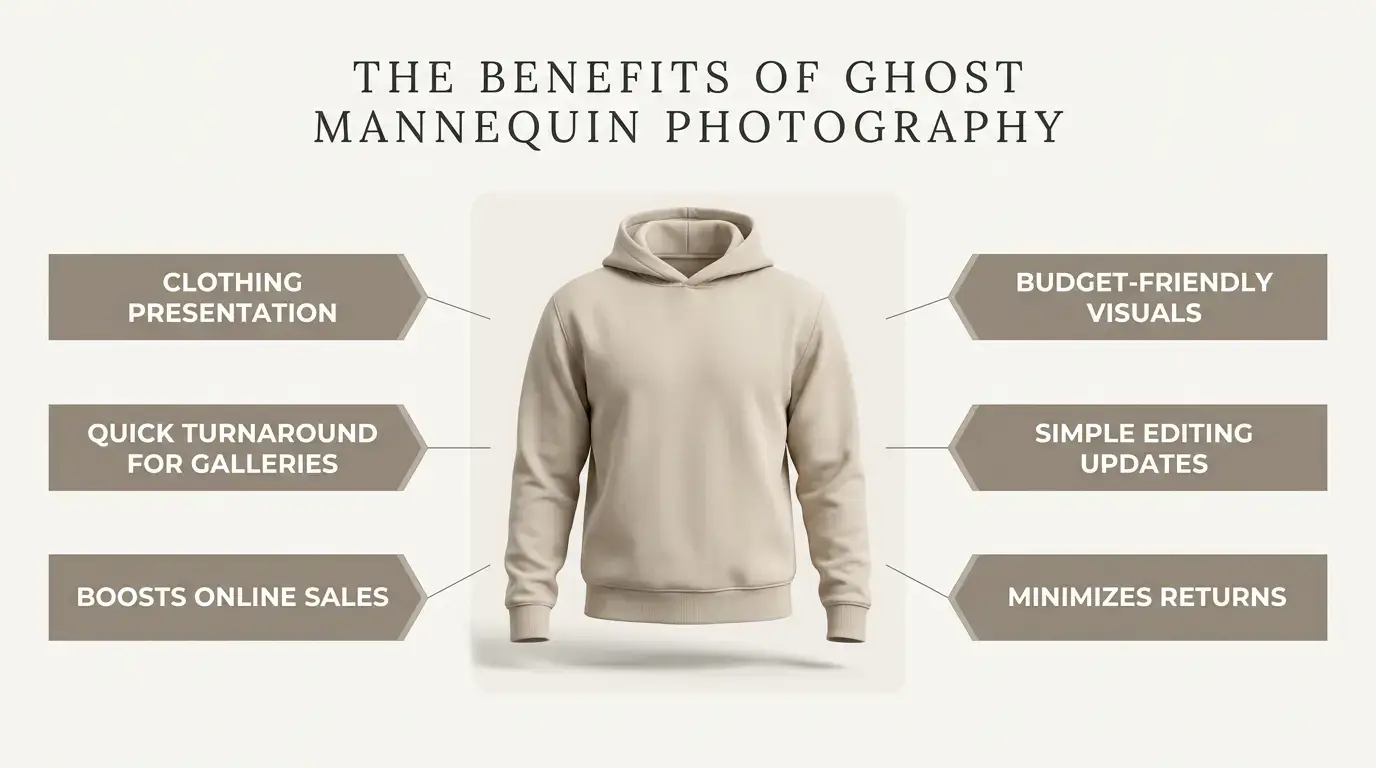
The biggest advantage is shape. A hollow form shows how a jacket structures at the shoulders or how a tee drapes, which a flat photo struggles to communicate. Customers get a clearer sense of fit before they ever click add to cart.
The second benefit is consistency. Because the mannequin is removed, every item can share the same framing, angle and background. A catalog of five hundred products starts to look like one coordinated brand rather than a pile of separate photoshoots.
Cost and speed are the third. You do not need to cast models, manage schedules or reshoot when a style changes color. You photograph the garment once and edit it. For brands with frequent drops, that flexibility adds up quickly.
There is also a practical angle. Mannequin photos are easier to reuse across product pages, ads, email campaigns and marketplaces, because the clean cutout works on almost any background.
Ghost Mannequin vs. Flat Lay Photography for eCommerce
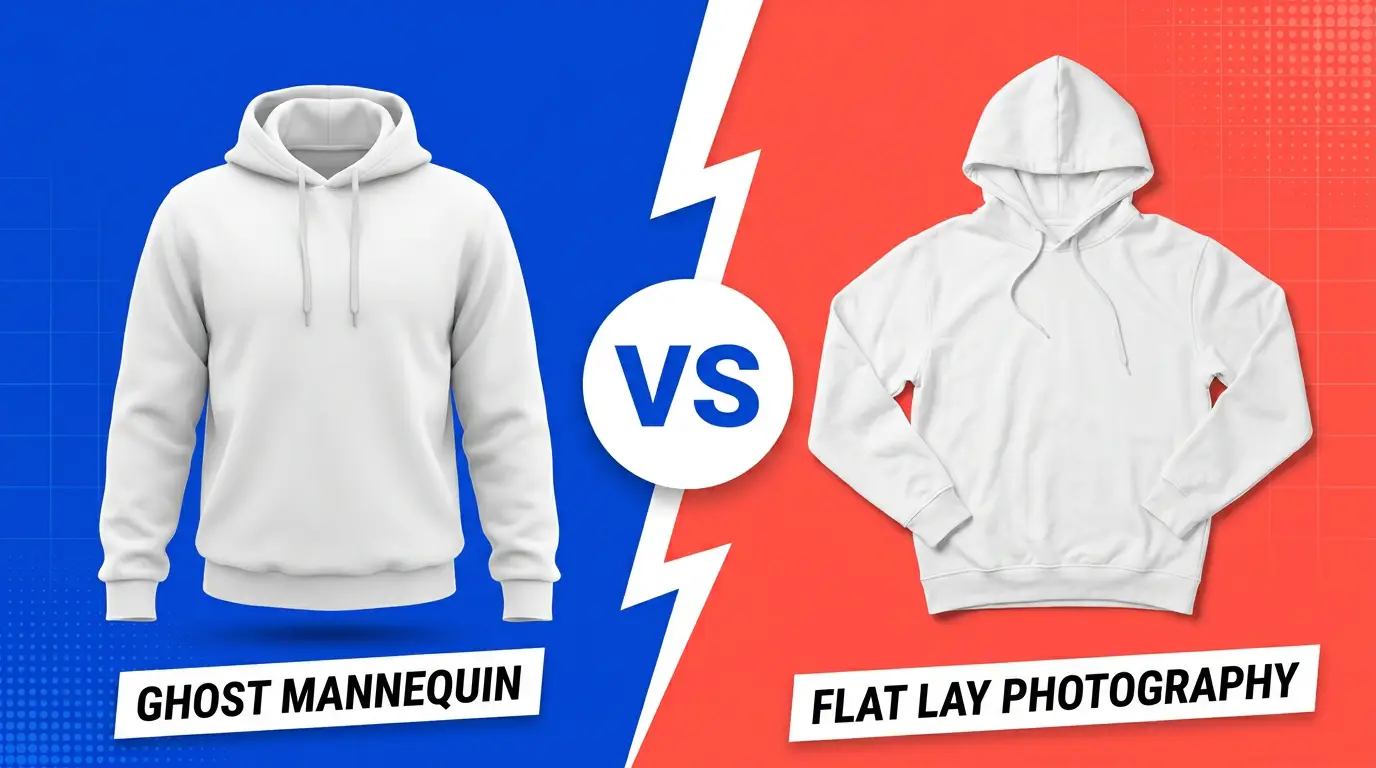
Flat lay photography is quick and cheap. You arrange the garment on a surface and shoot from above. For accessories, folded knitwear or casual social content, it works well.
The weakness is that clothing does not look like clothing when it is lying down. Collars collapse, sleeves flatten, and the buyer has to imagine how it will hang. Ghost mannequin images show volume and structure, which is why they tend to feel more premium on a product page.
A simple rule of thumb: if the shape of the garment is part of the selling point, ghost mannequin usually wins. If the item is soft, small or sold mostly on pattern, flat lay can be perfectly fine. Plenty of stores use both, ghost mannequin for the main image and flat lay or detail shots for the gallery.
Which Apparel Products Benefit Most From Ghost Mannequin Editing?
Structured and shaped garments gain the most. Think blazers, jackets, coats, button-up shirts, polos, dresses, hoodies and sweatshirts. Anything with a collar, lapels, a defined waist or noticeable sleeves benefits from the three-dimensional look.
T-shirts and activewear also do well, particularly when you sell dozens of colors and need them all to look identical. Bottoms such as jeans and trousers can be done too, though the waistband and leg openings call for more careful editing.
Items that tend to be less suited include very loose, sheer or heavily embellished pieces, where a mannequin shape may misrepresent the way the fabric moves. Footwear and small accessories usually need different techniques altogether.
Why US Clothing Brands Need Professional Ghost Mannequin Services
The US market is crowded and impatient. Shoppers compare multiple stores in a few minutes, and image quality is one of the fastest signals they use to judge whether a brand is trustworthy. Professional ghost mannequin services give you a way to look polished at a scale that is hard to maintain by hand.
Creating Consistent Product Images for Online Stores
Consistency is the quiet hero of good eCommerce design. When every image uses the same angle, spacing, shadow style and background, the store feels organized and the products are easier to compare. When one jacket is centered and another is cropped tight, the shopper notices, even if they could not say why.
A professional provider follows the same rules for every file. That means the same canvas size, the same margins around the garment, and the same shadow treatment from the first image to the last. It is the kind of discipline that is easy to promise and hard to sustain when several different people are editing on different days.
Improving Apparel Product Presentation Across Catalogs
Presentation affects perception. A well-edited garment looks cared for, and shoppers tend to assume the product itself is cared for too. Clean neck joints, even sleeves, accurate color and natural shadows all send the message that this brand pays attention to detail.
There is a flip side. Sloppy edits are not neutral. A visible mannequin remnant, a crooked collar or a muddy edge can make an otherwise good product look cheap, and it is a common reason shoppers abandon a page.
Supporting Shopify, Amazon, and Other Online Marketplaces
Most US apparel brands sell in more than one place. A Shopify storefront, an Amazon listing, perhaps Walmart Marketplace, Etsy or a wholesale portal. Each channel has its own image preferences, and a professional service can deliver the same garment in the formats and backgrounds each one needs, so you are not rebuilding files from scratch every time.
We will cover the specifics for Shopify and Amazon later in this guide. For now, the takeaway is that a good provider thinks about where your images will end up, not just how they look in isolation.
Managing Large Product Collections During Seasonal Launches
Seasonal launches are where in-house editing breaks down. Spring, back to school, Black Friday and holiday collections all arrive with tight deadlines and large batches of images. A small internal team can handle a normal week, but a launch can swamp it.
An outside team can absorb that spike. Instead of delaying a launch or pulling staff away from marketing and merchandising, you hand off the batch and get consistent files back on a schedule you agreed in advance. For many brands, that predictability is worth as much as the editing itself.
How to Choose a Reliable Ghost Mannequin Service Provider in the USA
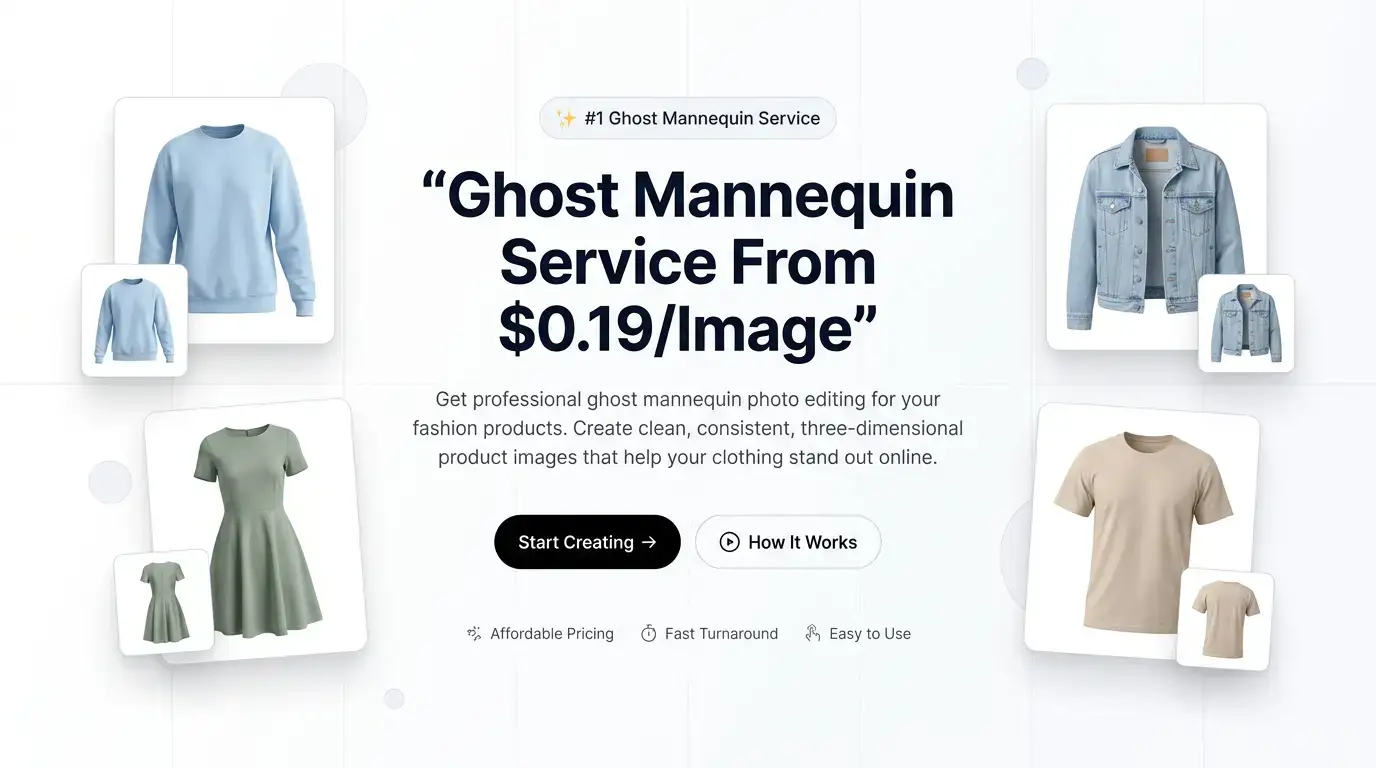
Here is where the decision actually gets made. Dozens of companies promise perfect results, and their websites look remarkably alike. The difference shows up when you look closely at the work and ask the right questions.
Review the Provider’s Portfolio and Before-and-After Samples
Start with the portfolio, but read it critically. Look for before-and-after pairs that show real garments, not only simple t-shirts on a flawless mannequin. Ask yourself whether the examples include hoodies, jackets, collared shirts and dresses, because those are where weaker editors struggle.
Pay attention to variety. If every sample is the same easy product, you have learned very little. A strong portfolio shows a range of fabrics, colors and complexity, and it matches the kind of clothing you actually sell.
Check Neck Joint Editing, Fabric Details, and Natural Shadows
Zoom in on the neckline. This is the single most revealing area of ghost mannequin work. The inside back of the collar should look believable, the label area should be tidy, and the seam between the main shot and the interior shot should be invisible.
Then check the fabric. Good editing smooths distracting wrinkles but leaves the weave, knit or texture alone. Over-smoothed garments look plastic. Finally, look at shadows. A soft, natural shadow grounds the product. No shadow makes it float, and a heavy, fake one looks pasted on.
Evaluate Color Accuracy and Edge Quality
Color mismatches are a major driver of returns. If the navy sweater arrives looking black, the customer will notice. Ask how the provider handles color, whether they work from your reference photos, and how they deal with color casts introduced during the shoot.
Edge quality matters too. Look for clean, natural outlines without halos, jagged pixels or leftover background fringing, especially around hair-like textures such as fleece, wool and fringe. Zoom to one hundred percent on a few samples. Problems that hide at thumbnail size jump out at full size.
Compare Pricing, Revisions, and Turnaround Times
Looking at price alone is a trap. A very low rate can hide limited revisions, slow delivery or a quality level that forces you to redo work. Ask what counts as a revision, how many are included, and how quickly corrections are handled.
Turnaround deserves the same scrutiny. Providers often advertise fast delivery for a single image, but your bulk order is what matters. Ask what a realistic timeline looks like for your volume and whether rush options exist before a launch.
Review Communication, File Security, and Quality Control
The best editors in the world are not much use if you cannot reach them. Notice how quickly and clearly a provider answers your questions during the sales process. That is usually a preview of how they will communicate once you are a client.
File handling also matters, especially for unreleased collections. Ask how images are transferred and stored, who has access, and whether the provider is willing to sign a confidentiality agreement. Finally, ask about quality control. A reliable provider has a review step before delivery, not just a single editor working alone.
Best Ghost Mannequin Editing Services for Bulk Orders
Bulk work changes the questions you should be asking. Editing one image well is a craft. Editing a thousand images to a consistent standard is an operation, and not every provider is set up for it.
How to Manage Hundreds or Thousands of Product Images
Organization is half the battle. Before you send anything, agree on a naming convention, a folder structure and a way to flag priority items. Sending a mess of files named IMG_4521 guarantees confusion on both sides.
Batching helps too. Send images in logical groups, such as by collection or garment type, and ask for delivery in the same groups. That makes review faster and keeps small problems from hiding inside a huge folder.
Maintain Consistent Editing Across Large Catalogs
When many editors work on one project, drift is the enemy. One person adds a slightly stronger shadow, another trims the canvas a little tighter, and suddenly your catalog looks inconsistent. Ask how the provider keeps standards aligned across their team.
The best way to protect yourself is a written style guide. Spell out canvas size, margins, shadow style, background color and file format. A reliable provider will welcome it, and may even help you draft one.
Understand Bulk Pricing and Volume Discounts
Volume usually earns lower per-image rates, but the structure varies. Some providers publish tiered pricing, others quote custom rates for larger batches, and some offer monthly plans. Ask for the terms in writing, including what happens if your volume changes from month to month.
Watch for exclusions. A discount that only applies to simple garments is not much help if your catalog is full of jackets and dresses.
Choose a Provider That Can Scale With Your Business
Think about where your brand will be in a year, not just this season. A provider that handles two hundred images comfortably might struggle with two thousand during peak periods. Ask about team size, typical monthly volume, and how they handle sudden spikes.
It also helps to find a partner that is flexible in both directions. You want someone who can handle a single urgent image today and a large launch next month without forcing you into rigid contracts.
How Much Do Ghost Mannequin Editing Services Cost in the USA?
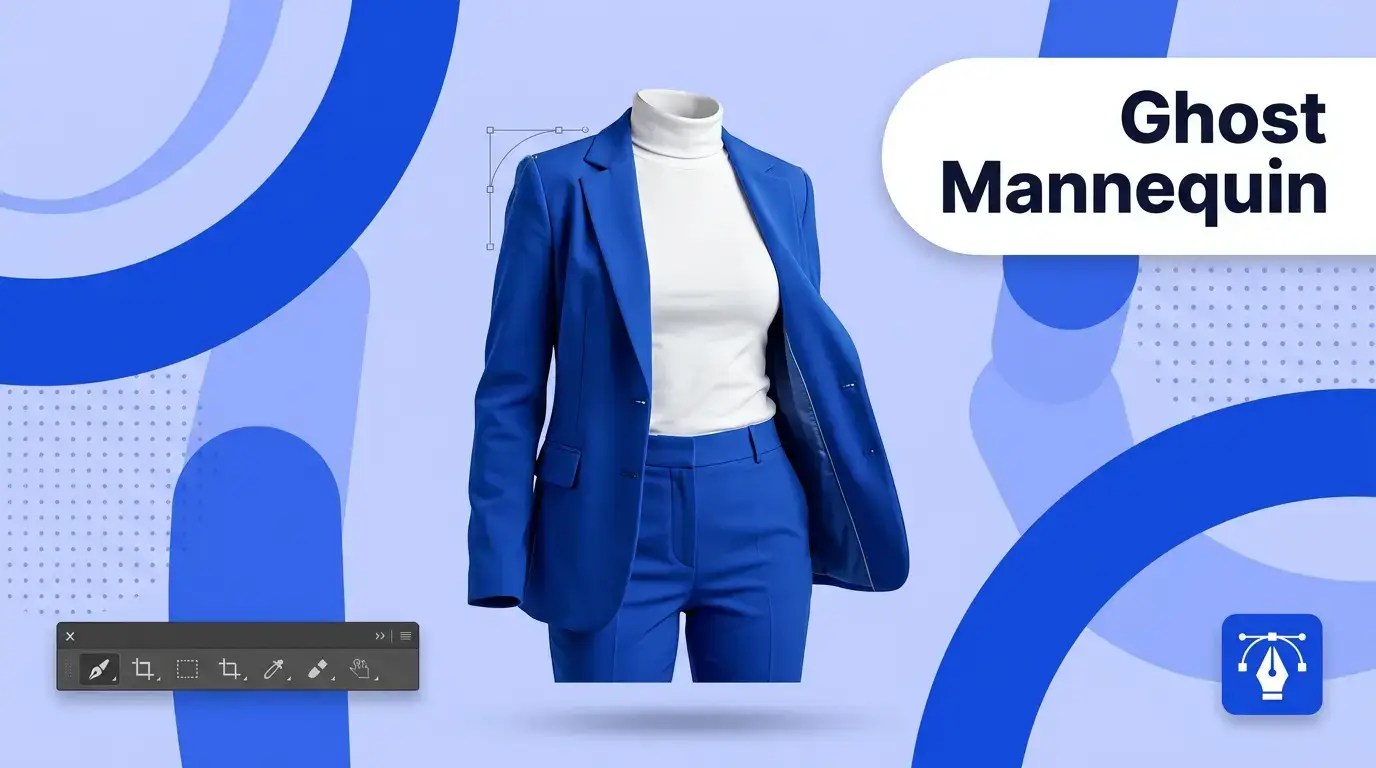
This is the question everyone asks first, and the honest answer is that there is no single US price. Rates depend on garment complexity, volume, turnaround and the provider’s location and business model. To give you real reference points, we looked at what providers currently advertise on their own public pages (checked October 2026). These are advertised starting rates, not a verified US average, and many of these companies serve US clients from outside the country.
| Provider (public page) | Advertised starting rate for ghost mannequin |
| Path | About $0.89 per image for simple edits; $1.79 for complex edits |
| Pix Clipping Path | From $0.99 per image |
| Color Clipping | Pages show starting rates of $0.49 and $0.79 per image |
| Clipping Path Studio | From $0.60 per image |
Two things stand out. First, advertised starting prices cluster below a few dollars per image, but they are explicitly starting points and the final quote depends on complexity. Second, other sources quote much higher figures. One AI tool vendor’s FAQ puts outsourced ghost mannequin work at roughly $5 to $25 per image, and a studio-based comparison suggests $15 to $50 per SKU once shooting and editing are combined. Those numbers include different services and come from companies with their own agendas, so treat them as a reminder that scope matters, not as a benchmark.
Prices change often, so confirm current rates directly with any provider you are considering.
Factors That Affect the Cost Per Image
Complexity is the main driver. A plain t-shirt with a simple neckline takes far less time than a lined blazer with lapels, a hood and a zipper. Providers usually sort images into tiers for exactly this reason.
Other factors include the quality of the source photos, how many views you need per garment, the output specs, whether you need additional retouching, and how fast you need the files back. Faster turnaround often costs more.
Single-Image Pricing vs. Bulk Editing Packages
Single-image pricing is flexible and transparent, which suits small shops testing the service or handling occasional orders. Bulk packages trade some flexibility for lower rates and more predictable budgeting.
If your volume is steady, a package often wins. If it swings widely between seasons, look for a provider that offers volume pricing without long minimum commitments.
Additional Costs for Complex Neck Joints and Retouching
Base rates rarely cover everything. Complex neck joints, where an extra interior shot has to be blended in, may be priced separately. So can wrinkle removal beyond the basics, color correction, custom backgrounds, shadow variations and rush delivery.
Ask upfront what is included. A rate that looks cheap but excludes the neck joint work is not actually cheap if every garment you sell has a neck.
How to Compare Quotes From Different Providers
To compare fairly, send every provider the same test batch and the same written brief. Include a few simple garments and a few difficult ones. Then compare the total cost, what is included, the number of revisions, delivery time and, most importantly, the quality of the sample results.
A useful habit is to calculate the effective cost per usable image. If one provider is cheaper but needs three rounds of revisions, the real price may end up higher than a more careful competitor.
Ghost Mannequin Services for Shopify and Amazon Sellers
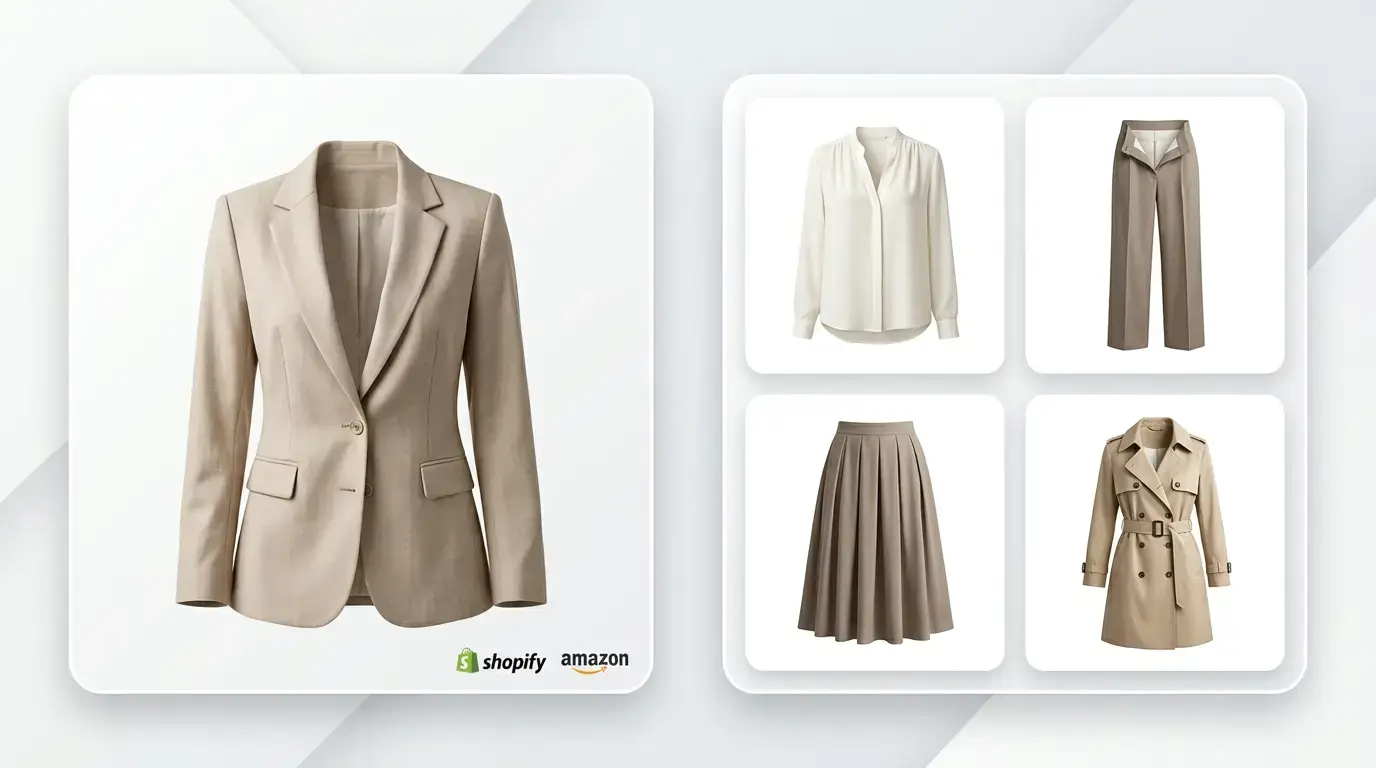
Shopify and Amazon reward different things, and the same garment often needs slightly different files for each. Planning for both at the start saves you from reworking images later.
Preparing Apparel Images for Shopify Product Pages
Shopify gives you freedom, so consistency has to come from you. Choose a canvas ratio, a margin and a background and stick with it across the whole store. Many themes display images in a uniform grid, which means inconsistent framing is immediately obvious.
Provide high-resolution files so the theme can resize them cleanly. Shopify’s own guidance has suggested large square images in the region of 2048 pixels, but check the current documentation and your theme’s recommendations, since both change.
Meeting Amazon Main Image Requirements
Amazon is stricter. Seller resources summarizing its rules consistently describe the main image as needing a pure white background (RGB 255, 255, 255), no text, logos or watermarks, and a product that fills most of the frame, commonly cited as 85 percent or more. Minimum size is generally given as 1000 pixels on the longest side.
As those same guides note, mannequins are generally not allowed in main images, apart from certain exceptions, while apparel may be shown flat or on a model depending on the category. Ghost mannequin editing is popular here precisely because it delivers the shaped, mannequin-free look. Amazon updates its policies, so always check Seller Central for the current rules for your category before submitting.
Optimizing Product Images for Zoom and Web Performance
Shoppers zoom in on fabric and stitching, so resolution matters. Amazon-focused guides often recommend going well above the minimum, in the range of 1500 to 2000 pixels, to enable a good zoom experience.
But bigger files slow pages down, and slow pages lose sales. The practical answer is to keep a high-resolution master, then export compressed web versions in modern formats where your platform supports them. Ask your provider whether they can deliver both.
Maintaining Consistent Images Across Multiple Sales Channels
The smart workflow is to edit once, then export for each channel. A single master file, with a clean cutout and true-to-life color, can be placed on white for Amazon, a brand background for Shopify and a transparent layer for ads.
If your provider understands this, you avoid duplicate work and keep the garment looking identical everywhere a customer might find it.
How to Test Ghost Mannequin Editing Quality Before Ordering
Never place a large order based on a website alone. A short test costs little and tells you almost everything.
Request a Sample Edit or Free Trial
Many providers offer a free sample or low-cost trial. Take advantage. Send two or three of your own images, ideally including your hardest garment, rather than choosing the easy one.
Using your own files matters because portfolio samples are always the best work a company has ever done. Your files show what you will actually receive.
Check Garment Shape, Neck Joints, and Fabric Texture
When the sample comes back, review it at full size. Is the garment shape natural and symmetrical? Does the interior of the collar look believable? Is the fabric texture intact, or has it been smoothed into plastic?
Compare it with the original, and check the color against the real garment if you have it nearby. Small errors at this stage are warnings about what happens at scale.
Test Revision Policies and Communication
Ask for one small correction on purpose. How quickly do they respond? Do they understand the instruction the first time? Is the fix clean, or does it create a new problem?
This little experiment reveals more about the working relationship than any sales call. Providers who handle feedback gracefully now will handle it gracefully later.
Confirm Quality Before Placing a Bulk Order
Once the sample passes, start with a modest paid batch before committing to the full catalog. Judge consistency across that batch, not just the quality of any single image.
If the results hold up and the process feels smooth, scale up. If not, you have only lost a small amount of time and money.
Should You Outsource Ghost Mannequin Editing or Use AI?
AI ghost mannequin tools have improved quickly, and they are now a real option. That does not automatically make them the right option for every brand.
Professional Manual Editing vs. AI-Assisted Editing
Manual editing means a trained retoucher works on each image, making judgment calls about shape, shadows and fabric. It handles unusual garments and tricky details well, and a human can spot when something looks wrong.
AI-assisted editing uses software to generate the effect automatically, often in seconds. It can be impressive on simple, clean images, but results vary with complex garments, intricate patterns, lace, sheer fabrics and unusual cuts. Some providers combine the two, using automation for the first pass and a human for finishing.
Comparing Quality, Cost, and Turnaround Time
On cost and speed, AI usually wins. Tools in this space advertise per-image costs far below manual rates and results in seconds rather than days. On consistency for difficult garments and fine detail, skilled manual work usually still has the edge.
Be careful with vendor claims, since most of the comparisons you will find online come from companies selling one side of the choice. Run the same test garments through both approaches and judge the results yourself.
Which Option Works Best for Growing Clothing Brands?
For most growing brands, the answer is a mix. Use automation where it genuinely performs, on simple, repeatable items, and use professional editors for hero products, complex garments and anything that represents your brand at its best.
The mistake is picking purely on price. A cheap image that needs correcting, or that quietly hurts your brand’s credibility, is not a saving.
Why Choose GRASIGNER for Ghost Mannequin Editing Services?
If you are comparing providers, GRASIGNER is built around the needs of apparel and online sellers who want clean, consistent images without managing the editing themselves.
Professional Editing for Apparel and eCommerce Product Images
GRASIGNER focuses on image editing for clothing and eCommerce brands, with attention to the details that decide whether a ghost mannequin image looks professional: neck joints, fabric texture, natural shadows and accurate color.
Flexible Solutions for Individual Images and Bulk Orders
Whether you need a handful of images this week or a full seasonal catalog, the service is designed to handle both. You do not have to commit to a large order to get started.
Consistent Quality and Clear Communication
Consistency across a catalog is what separates professional work from patchy work, and clear communication keeps projects moving. You should always know what is being delivered, when, and how to request changes.
Request a Quote or Sample Edit From GRASIGNER
Ready to see the difference on your own products? Explore the GRASIGNER Image Manipulation Service or go straight to the Request a Quote page to ask for a quote or a sample edit.
Frequently Asked Questions
1. How do I choose the best ghost mannequin service provider in the USA?
Start with a portfolio that matches your garment types, then test with a sample of your own images. Check neck joints, color accuracy, shadows, revision policy, communication and file security before you commit.
2. How much does ghost mannequin photo editing cost per image?
It varies widely. Several providers advertise starting rates below a few dollars per image, with higher prices for complex garments, while other sources quote much higher figures depending on scope. Always request a quote based on your actual images.
3. Can I order bulk ghost mannequin editing services?
Yes. Many providers support bulk orders with volume pricing. Ask about team capacity, consistency standards and delivery schedules for your volume.
4. How long does ghost mannequin editing take?
Turnaround depends on volume, complexity and the provider. Some advertise delivery within hours for small orders, while larger batches take longer. Confirm timelines in writing, especially before a launch.
5. Are ghost mannequin images suitable for Shopify and Amazon?
Yes, with the right preparation. Ghost mannequin images work well on Shopify, and they suit Amazon main images when delivered on a pure white background that meets current size and content rules. Check each platform’s latest guidelines.
6. Can I request a free trial before placing a bulk order?
Many providers offer a free sample or trial edit. If a provider does not, ask for a small paid test batch so you can judge quality before scaling up.
7. Is professional ghost mannequin editing better than AI editing?
It depends on the garment. AI can be fast and affordable for simple items, while professional editing generally handles complex details more reliably. Many brands use a combination.
8. Can I outsource ghost mannequin editing to an international company?
Yes, and many US brands do. Look at communication, time zone overlap, data security, confidentiality terms and the quality of a test sample, not just the price.